

-
Pages
-
Categories
-
Archives
Blogroll
-
RSS Feeds
-
Meta
 The.American.Word.
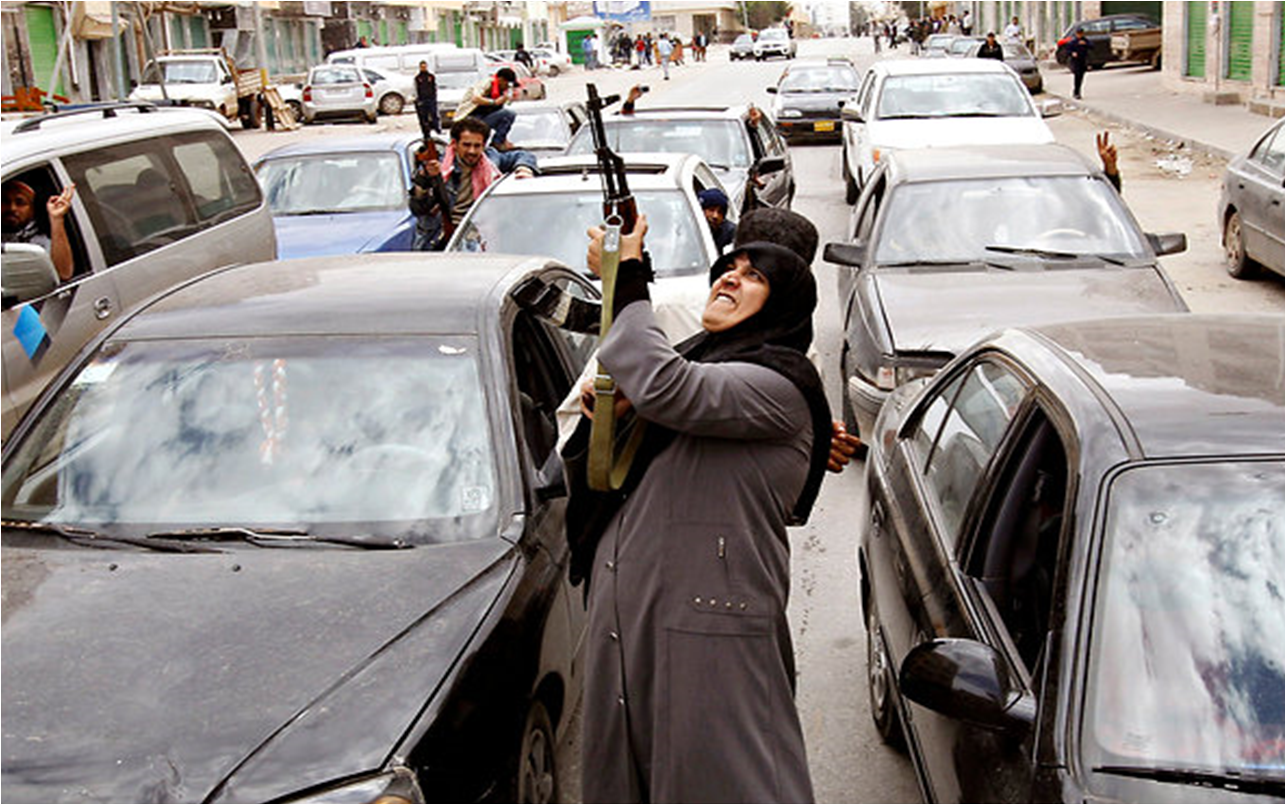
Writer Jon Lee Anderson described President Obama in the New Yorker this week as a man “torn between the imperatives of rescuing Libyan innocents from slaughter and not falling into yet another prolonged war.” Quite right, we think, and an illustration of the moral challenges of statecraft and military decision-making in a world that is clearly far from grace.
There is no good option for Obama, and for our nation. Any action taken – including, specifically, the actions taken in the past ten days – will cause ugly and unforgivable harm. Certainly some innocents will die when we bomb from the sky. Certainly even those uniformed and ready-to-strike government soldiers we target, whether they be about to gas and bayonet a group of protesters or press the button to launch a rocket, count among themselves frightened young men who wear the uniform as a better alternative to exile, death or other punishments.
We cannot avoid doing grievous harm here; the question is which harm is worse – fighting against Khadaffi’s forces as they attack their own population, or standing back and doing nothing (also known in the language of national capitals as “diplomatic action.”)
Some argue that we have no “interests” at stake in Libya; one wag has gone as far as to say that the requirement for “strategic national interests” to be at issue is “axiomatic.” We take that to be something like “because I said so.”
There are questions of human dignity, of the ability to succeed, and of connection to a genuine innocent party on the ground requesting help that all have definite answers in this case. Among the tragedies of our other wars is that having acted too quickly and with too little regard for the interests and perspectives of others, we are now conditioned to say no, to hold back, to question the moral foundations of ideas like “never again.”
We note that our nation – as of this day – is acting with moderation, but acting with due force. We are, for the moment, the good guys.
Dear Mom,
I told Clay the story of my hairdryer as we were driving home late from school one night this past month. I felt it was time to share one of my very personal stories that not many have heard and which I hold close and dear to my heart – a story about giving, where the gift does not have to be expensive. Here it is to the best of my memory as told to my twelve year old in slow-and-go traffic on La Cienga Blvd.
It was not just any hairdryer. I was a teenager, somewhere between fifteen and seventeen. It was my and my sister Helen’s birthday (we were born only 363 days apart). The two birthday presents were wrapped and lying in front of the fireplace on the red bricks under our mantle where gifts and goodies like our Easter baskets were always placed.
Mom called us over to wish us a happy birthday and apologized to Helen and me that it was something small. I believe Helen knew as well as I did that money was tight as Dad had left us and Mom was paying all the bills, including private school for me and my three sisters. I remember Mom’s eyes tearing up as she told us she loved us.
Helen and I opened our gifts and I saw that we’d received the same type and color of hairdryer. They were both off-white with dual switches, one switch blue and one red to control the speed and temperature of the hairdryer. If I remember correctly they were Panasonics, probably around $20 from Walgreen’s. Mom knew that we both blew our hair, in the style of the early eighties even though my sisters would argue that I knew nothing about style.
Even though I did not know what or how to feel, I know these gifts came from my mom’s heart and love. I might have been fighting back the tears as Helen and I thanked her and gave her a hug. I believe we would have been happy with one of mom’s famous birthday dinners and birthday cakes which was a grand tradition in our house, a gift we continue in our home today.
The story does not end here. I used this hairdryer as well as my sister’s throughout my teenage years, sharing the one bathroom in our house with four ladies.
Every time I used it, I remembered that it was a birthday gift from mom on a birthday when I was not expecting a gift. I am not even sure whether she even realizes today that her simple act of giving me a hairdryer has touched and enriched my life.
I took the hairdryer to college. For four years, from dorms to on- and off-campus housing it always worked for me and my three roommates. In college, every time I saw it or used it I remembered that it was a special gift, and I remembered my mom. I remembered that it was gift given out of love and sacrifice for her children.
This white, dual-switched hairdryer was a link to what love is. My mom’s love is unconditional – she would sacrifice so much for me and my three sisters and never know how difficult it was.
I was away at college and was not present every day like my sisters Lisa and Helen to witness the many hardships. I wanted to believe that it was easier with Patrice and me away at college, and Lisa helping out financially. I do not know this as a fact just a feeling. Mom helped me with tuition and round-trip air fare every Thanksgiving, Christmas, Easter and end of term. I do not know how she did it yet I do understand it and feel her particular kind of love more now that I have three boys of my own and the love of a father for his children.
The greatest gift can be as simple as a $20 hairdryer. Some gifts are given with so much love that you may not even realize the depth of that love at the time. You, Clay, like your brothers, are gifts to mom and dad.
Do you remember when I told you one of the greatest gifts I can give you is your faith journey in God? My mom gave me my faith journey. She passed it on to me. And when you were first born as I was holding you in the hospital and thanked God for you, I promised God that I would pass on the faith journey my mom gave me.
The story does not end here. This inexpensive hair dryer never got left behind. I always packed it carefully as it was dear to me.
After graduation, I moved to Florida for all the wrong reasons. I did not toss the hair dryer away or give it to someone. No one would have thought twice had I forgotten it or left it behind. It was old and dirty with lint in the filter. It had been dropped and banged around for years. Some would probably just have tossed it. And I wasn’t even blowing my hair dry anymore. Still, I kept it.
And then one day in Florida, my girlfriend was using the hair dryer and it simply stopped working. I cried. The girlfriend could not and did not understand. She said she would buy me a new one.
I started to explain, but then I stopped trying to explain. This was my history and she could not empathize. I cried a little more.
I no longer have the hair dryer. Do you know what I think of when I see or hear a hair dryer? I think of my mom and the many gifts and sacrifices she has given me.
I shared this story to pass a gift on to Clay and realized I wanted and needed to share this with you – Mom – as you may not know how some of your many gifts have been received. Now I have the honor and love as a father to share your gifts with my sons and that is my gift to you.
Merry Christmas,
Jeff
Rebecca Berger writes from Bhuj, India:
One of the projects I’ve been working on here is an initiative to teach representatives of local village governments to use online tools and social networking for improved governance and advocacy. Sound a little crazy? Well, it kind of is.
I suppose there’s an important context behind this that might help in painting a more detailed picture, and would help in understanding what the NGO I work for actually does. So, we’ll start from there.
The Indian government adopted a system that promotes the election and governance of Panchayati Raj Institutions. These are small, locally and democratically elected governments at the village level – each governing about 500 people – combining villages or hamlets when they are too small, in order to form a substantial reach of governance. These governments are called Gram Panchayats. There are Gram Panchayats at three levels – the village level, the block level, and the district level. (Above the district level is the state level, but the state level government is then a part of federal elections).
Here in Gujarat, however, the state-level government, run by Chief Minister Navendra Modi (see the NYT front page article on him HERE) and the conservative, Hindu-nationalist party the BJP, are committed to creating a state that is wide open to business – connecting the rest of the world to India via the state’s many ports and Special Economic Zones.
So, because Mr. Modi is determined to keep corporate interest in the state high there is great incentive to keep all governance centralized, under the control of the State government. In this way, they can ignore all those pesky villagers whose claims to traditional livelihood activities, connection to land, and demand for public services simply get in the way of turning the state into one giant, ugly polluting factory.
One of the ways we’ve begun to organize these Panchayat groups is by teaching them online skills.
First, we taught them all Facebook, which resulted in a very interesting list of characters requesting to be my friends on Facebook. We taught them Skype, to enable better and less expensive connectivity, and now we are teaching them blogging. In fact, I am blogging in the blogging training as I write.
This session has by far been the most interesting in terms of issues that have come up with the ‘enablers,’ and also the most exciting. In the spirit of all the has happened in Egypt, and a new generation of revolution that exists because of the internet – I can’t help but feel like sitting in this room, I am a part of something innovative, exciting, cutting-edge and in its own little-way, revolutionary. (Or, perhaps I just try to convince myself of this because it’s more appealing than admitting that in reality, I am sitting in a room with 20 people and we are all starring into our computers for the entire day).
But what is exciting – is seeing people, for the first time, learn to value their work and themselves. These “enablers” are really at the forefront of grassroots change. Every day they engage with people – educating them about their rights, connecting them with resources to make change in their communities. But they’ve never had the opportunity to connect outside of such localized development. Because they are so engrossed at the grassroots, they have difficulty seeing that they fit somewhere in a greater picture.
For them, it’s just what they do. They are getting by with a salary of approximately $100 / month, and this is just their every day reality.
But to create a blog, to post one’s background, one’s work, one’s motivations – is, in essence, to express oneself to the world. The story of our work and why we find it important – these are extremely powerful stories. And telling them is empowering. All of a sudden, these little committees that have other people write reports about them are themselves writing to the world about what they do. This is huge.
Vying for media attention these days, often neck-and-neck, we find the public self-immolation of actor Charlie Sheen and what seems to be a genuine people’s revolution in Libya.
The modern American revolutionary Abbie Hoffman, upon returning from a decade of living underground – mostly in northern New York State, where he worked as a cook – and taking back up his public role as gadfly and pot-stirrer, remarked that “you can’t be a revolutionary in America without watching a lot of TV. That’s where America lives.”
This was certainly truer when Hoffman spoke these works, when most cities had a dozen channels for viewers to choose among, and the “Big Three” networks were minting money through their media oligopoly. Times are certainly different, but the two sides of the Sheen/Libya coin suggest that the mainstream media are either appealing at once to two remarkably divergent publics, or that thoughtful people have an appetite for compelling if ultimately trivial self-destructive behavior, while the consumers of mindless drivel also care to at least some tiny degree about democracy, human aspiration, and the fate of the world.
If Sheen is a minor Greek god caught mid-fall from Olympus, Libya is the famine or the war taking place closer at hand to the Greek demos. The real and the unreal. The fantastic and the mundane. The distracting and the truly horrifying. We are entertained with the worst kind of voyeuristic circus. And we are offered a glimpse of history’s propulsive force, of human dignity fighting for its life. We seem, as a society to want both stories to be told to us in more or less the place, at more or less the same time.
We seem – as a culture – unable take only part of the sphere of stories that arches over us. Yet each of us can choose to stand closer to this fragment, this figment, this corner of the story-telling world, than that one. We can fight our way over to the meaning of sacrifice, revolution and hope, and claim that bit of space, or we can be buffeted from here to there, be fed the news others want to feed us.
Our choice is not so much which battle to fight, but which battle to watch.
Trivial as that might seem, it’s a choice that matters.
Red Squares (May 1, 1992)
I.
Fortress walls of the Kremlin thunder once again. Loudspeakers drone out the laughter of orphans dancing. Folk dancers, clowns posing for photos, bears dancing the Lambada, and Russian army jazz musicians: All fold up their tents.
Red flags wave beside the bus-barricaded Revolution Square. The thousands march, chanting “Down with Yeltsin!” Red banners embroidered in gold. Chests proudly port Five and Dime store medallions. Relics scrapped in the ash heap of Party annals.
Goo-goo eyed, sub-urban children now snap photos of St. Basil’s Cathedral, then coo at the high and long step rhythm of the changing of the guard, “Juri, where are you???” Searching for their guide, Innocents Abroad brush aside Old Believers.
“Lenin should be buried along with the rest of you,” Juri scowls. Looking for a fist fight, he regrets not being there the day the empire popped like a Zeppelin but somehow without dropping from the sky in flames.
His friends— defiant— stood up upon a tank, their photo immortalized. “You’re lucky to be on the winning side,” I tell him, “After Tiananmen, satellite images still tell a thousand words.”
A moment of silence. “Lenin! Lenin! Lenin!” the Old Believers shout.
But there is no transmigration of souls: The embalmed one declines the invitation of the Spanish tourist board to visit the Canary Islands.
His sarcophagus winces in grief: Upon the façade of the old Dumas he so detested, black letters in Russian and English blare in new Newspeak, “Freedom Works!”
The ceremony comes to a close. Old Believers file from the square, cursing Innocents Abroad. Knives darting from their eyeballs slash publicity desecrating such hallowed turf.
Before the former Karl Marx Metro stop, clarinets sway from out of the roaring twenties. Son of Fuehrer II clichés in stereophonic sound.
Autograph hunters supplicate before the gaze of a celluloid star. I buy his newspaper but foreswear his signature, my guilty fingertips now smudged with radioactive ink.
II.
I talk to the one man in the crowd who will respond in English.
Tall, aristocrat of the street, long white coat, a high school English teacher, he tells me in perfect English, “he just loves to talk to foreigners,” he says (for a few dollars, it is understood)— and has corresponded with a “delightful” lady in Holland for many years.
His eyes never look directly at me.
Speaking Jabberwocky, we discuss the global ramifications of Humpty Dumpty’s fall in front of the Bolshoi while sub-urban children collect Red Army souvenirs and haggle for scalped tickets (starting at twenty dollars, getting down to five, sometimes even less).
One young soldier is willing to sell his pants for a few greenbacks; my street guide tells me that, by the way, he also has caviar and army uniforms to sell…. As if on a fashion runway, sub-urban children then port their newfound khaki camouflage to Swan Lake— to the evident disdain of the audience.
Then, as he stares [ ] into the clouds, he tells me that his son just happens to be a fighter pilot in the Far East and has much to tell me— but he’s not permitted to speak to foreigners, he adds.
Needless to say, I decline the invitation.
—1992
 The.American.Word.