Category Archives: Uncategorized

Angel Conoesto – Poem (“Again Falling”)

Again falling, my hand opens
and the air is my salvation.

Again falling, I see the layered airs of my city
and its dirty streets, opening to the secret other

city, the home of a thousand lost children
and their grizzled fathers with work-locked

hands, again falling to the last outpost
of their aspirations, or their first occasions

of grief. Again falling, can you see
that all of it, all of

them are here?

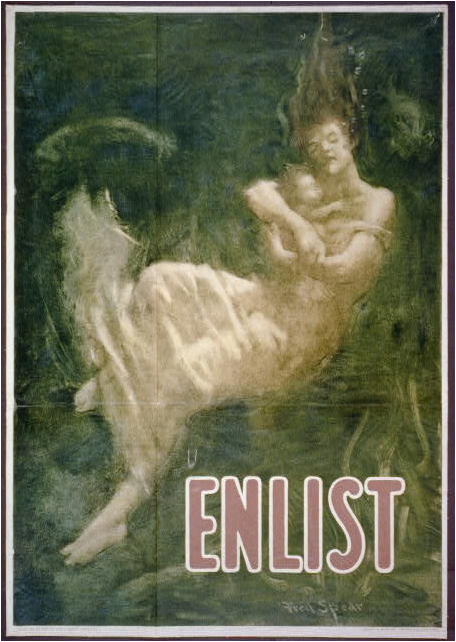
Frank Spear – Poster (ENLIST – image of drowning woman and child, from the sunken ship Lusitania)

Peter Temes – Radiation

My father – Lloyd Temes – was a teacher, though teaching was not his first profession. He’d become an engineer after finishing his degree at New York’s City University. He was surprised, though, by how little joy he took from corporate and military engineering.


Before he was out of his twenties, he began his first high school teaching job. It put him on a trio of busses each day, twice a day. He felt the pull of his new life – he now knew that he was a teacher, born for this kind of work – but his school was too far from home. When a spot opened up at a top math-and-science high school in much closer to his home in Brooklyn, he leapt.


He loved teaching. Three stories capture that love. None are about what he taught; all are about how he taught, and how he learned.


The first takes place in the junior high school he attended, though the important prologue to this story begins in fourth or fifth grade. “The teachers could really have a bad attitude,” he recalled later about those 1940’s classrooms. “And one day when a teacher made a particularly obnoxious remark, I climbed up on my desk and punched him in the nose.” This would have been in fourth grade, maybe fifth. My father might embellish a story now and then, but I believe this one. He never shied away from conflict, and he was unstoppable when he thought he was right.


Fast forward to junior high school. By seventh grade, my father was on what he later called the “pre-delinquent track.” He’d been put in a program for poorly-behaved students. They had minimal academic classes and spent most of each day working in the school’s printing shop under the guidance of a famously tough man named Johnny Fontana who had never been to college, was lucky to have a steady job away from the usual dark and dangerous sites of his industrial printing trade, and found in my father a boy with talent.


Fontana set firm limits for my father’s behavior and enforced them. Certainly it helped that he was bigger and stronger than the boy. He saw that my father had some natural aptitude for math and pressed him to study for one of New York City’s “challenge exam” high schools. Along with thousands of other New York City students, though perhaps the only representative of the pre-delinquent track, he sat for the exam and to the shock of many he passed. He entered Stuyvesant High School and worked like coal miner every day to earn passing grades. He was, my mother later observed, a plodder: bit by bit, he would work at every problem. More through determination than flashes of insight, he would get the work done, pass his classes, and hold onto his place in this elite institution.


Another story. My father made his way to the faculty of Brooklyn Technical High School – a school that held much in common with Stuyvesant – partly because he could teach physics, but partly because he could teach the radio electronics shop course there as well. Brooklyn Tech did not offer a pre-delinquent track, but the least-appreciated among the school’s bright students would often wind up taking shop. So my father knew them, and knew them with some of the warmth he remembered from his own shop class in junior high school.


Once day, he later told me, there was a rumor spreading at lunch that two groups of tough kids at the school had formed into gangs, had knives and chains, and were going to do some real harm when the school day ended. When the final bell rang, my father peeked out from the radio shop – not much bigger than a closet, he said – and saw a scene out of West Side Story: the toughest of the tough boys was at the head of a phalanx of his followers, heading quickly down the hall toward his opposite number. The leader of the first group ran within arm’s reach past the radio shop door. My father reached out, grabbed him, pulled him in and locked the door. “End of riot,” my father reported a couple of decades later, still quite proud of himself.


My father had a lot of stories like this, and I know that he believed in them fully. That was part of who he was – and a big part of why he was a great teacher: he was a believer.


A final story. My father taught high school science in the age of Sputnik. The Russian marvel, the first man-made object to orbit the Earth, unleashed a flurry of anxiety over the “science gap” and a river of money meant to supe up science in American schools. One particular experiment began with the interesting observation that helping average teachers become better at teaching might do more good than luring more top performers into the classroom, if only because there are (by definition) so many average teachers. The National Science Foundation was, therefore, given a sizable amount of federal funding to identify a group of average science teachers and place them inside the nation’s cutting-edge research facilities to see whether this exposure to the best and the brightest might inspire the teachers to better-than-average heights.


My father was one of those lucky average teachers, and his experience leaving Brooklyn to work for a season inside the University of California’s Lawrence Radiation labs did indeed transform him. But not at first. He arrived at the lab and was given a fairly mundane task, presumably well suited to an electrical engineer like my father. He was asked to make lightening.


In certain of the large vacuum chambers at the Radiation Lab, scientists were splitting atoms and sub-atomic particles were (they hoped) shooting off in various directions when these atoms ruptured. But it was all happening microscopically. Without some way to verify the paths of the subatomic particles, the scientists were not entirely sure that they were accomplishing what they thought they were accomplishing. But if the experimenters could throw a bolt of lightning into the chamber precisely when the atom split, the lightening would follow the path of least resistance – the path taken by the spinning-out particle – and light it up for all to see. So my father made lightning, and was fairly content with that task.


Every week, though, he found himself in a staff meeting at the lab, and seldom understood the conversation. He was ready to head home a failure, a science teacher but not a scientist, when a lab-mate asked him what was wrong. I can’t follow it, he confessed. I just don’t understand. Well, what’s your field, the other fellow asked. Electrical engineering, my father said, not expecting the distinction to do any good. Ah, came the reply. You speak another language. When they say this in physics, they mean that in electrical engineering. The language was the issue, the style of reference, not the depth of the concepts.


With this key in his hand, my father opened the stuck doors in front of him, and had a fine fellowship. He came back to New York, came back to teaching, took two master’s degrees at night and went on to complete a PhD part-time. He moved from his high school to a community college electrical technology department. There he used the work of an engineering professor named Mischa Schwartz to translate electrical engineering concepts into more basic language that allowed a generation of technicians without any higher math to do the kinds of repair and maintenance on serious electronics that were previously the province of engineers only.
So this idea stuck with my father through his career as a teacher: it’s never as hard as you think it is. Learn the language, figure out how the other guys are doing it, and you can do it too. The will to get it done is the part that matters most.

The Editors – A Higher Standard of Misbehavior

We keep reading the news about leaders American and otherwise, doing nasty things they clearly should not be doing, and wondering how much of a man’s bad behavior in the bedroom, hotel suite, or Twitter feed is the proper business of public debate.

The benchmarks, we suppose, range from JFK to FDR – and perhaps even to Mrs. Roosevelt. We the American public know a great deal today about the things each of these three iconic Americans did, in some cases with whom, that we are universally glad not to have known at the time of the doing.

Yes, hypocrisy is ugly, to say nothing of the various body parts implicated in any of a few recent public-figure scandals. But there ought to be a line somewhere about what disqualifies a man or a woman for public office, or for our vote.

DSK certainly crossed that line: assault is assault, if that proves to be the truth. And Rep. Wiener, the rank foolishness of the photos sent out across the vast electronic seas makes you not so much a moral danger, but perhaps a mental one. The departed governor of California surely deserves hell from his family – current and soon-to-be-former – but had he done brilliantly in office, who ought really to care come voting day?

We feel, in the final analysis, that we know too much about the wrong things about these men, and still not enough about their fortitude on the public behalf, their creativity in managing our collective concerns, and their true hearts. More of the clarity and commitments of, say, an FDR or a JFK, and less of pandering interest in the various underpants of all involved, would serve the nation well.

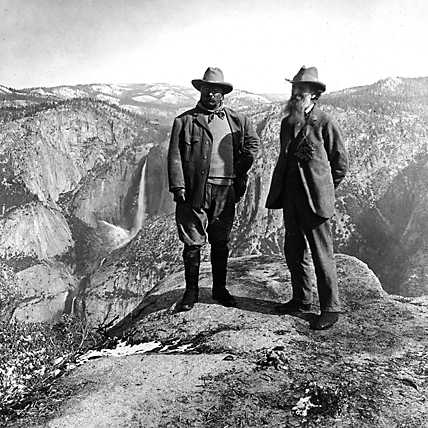
Library of Congress – Photo (Theodore Roosevelt and John Muir at Yosemite)

Benjamin Franklin – Letter (To Thomas Paine)

TO THOMAS PAINE.
[Date uncertain.]

DEAR SIR,

I have read your manuscript with some attention. By the argument it contains against a particular Providence, though you allow a general Providence, you strike at the foundations of all religion. For without the belief of a Providence, that takes cognizance of, guards, and guides, and may favor particular persons, there is no motive to worship a Deity, to fear his displeasure, or to pray for his protection. I will not enter into any discussion of your principles, though you seem to desire it. At present I shall only give you my opinion, that, though your reasonings are subtile and may prevail with some readers, you will not succeed so as to change the general sentiments of mankind on that subject, and the consequence of printing this piece will be, a great deal of odium drawn upon yourself, mischief to you, and no benefit to others. He that spits against the wind, spits in his own face.

But, were you to succeed, do you imagine any good would be done by it? You yourself may find it easy to live a virtuous life, without the assistance afforded by religion; you having a clear perception of the advantages of virtue, and the disadvantages of vice, and possessing a strength of resolution sufficient to enable you to resist common temptations. But think how great a portion of mankind consists of weak and ignorant men and women, and of inexperienced, inconsiderate youth of both sexes, who have need of the motives of religion to restrain them from vice, to support their virtue, and retain them in the practice of it till it becomes habitual, which is the great point for its security. And perhaps you are indebted to her originally, that is, to your religious education, for the habits of virtue upon which you now justly value yourself. You might easily display your excellent talents of reasoning upon a less hazardous subject, and thereby obtain a rank with our most distinguished authors. For among us it is not necessary, as among the Hottentots, that a youth, to be raised into the company of men, should prove his manhood by beating his mother.

I would advise you, therefore, not to attempt unchaining the tiger, but to burn this piece before it is seen by any other person; whereby you will save yourself a great deal of mortification by the enemies it may raise against you, and perhaps a good deal of regret and repentance. If men are so wicked with religion, what would they be if without it. I intend this letter itself as a proof of my friendship, and therefore add no professions to it; but subscribe simply yours,

B. Franklin

The Editors: The Healing Progress of Nothing Dramatic

The world is still with us, or so the observable evidence suggests, with this Saturday’s predicted Armageddon either delayed, canceled, or merely imagined all along.

And Donald Trump is no longer talking about President Obama’s lack of a valid, stamped, sealed U.S. birth certificate, one having been recently issued to the public by the state of Hawai’i.

And already, a number of presumed and hoped-for presidential candidates are dropping by the wayside, more often than not because the fringe hatreds that can gather a few thousand fierce supporters, enough to draw a crowd during the pre-game, remain unwanted by the broad sweep of Americans.

Less and less seems to be happening for the moment, and we are all so clearly better off for it.

Sam Rempell – Photo (“We Are Dreamers”)

Charles Olson – Poem (“Maximus to Gloucester, Letter 27 [withheld]”)

I come back to the geography of it,
the land falling off to the left
where my father shot his scabby golf
and the rest of us played baseball
into the summer darkness until no flies
could be seen and we came home
to our various piazzas where the women
buzzed

To the left the land fell to the city,
to the right, it fell to the sea

I was so young my first memory
is of a tent spread to feed lobsters
to Rexall conventioneers, and my father,
a man for kicks, came out of the tent roaring
with a bread-knife in his teeth to take care of
the druggist they’d told him had made a pass at
my mother, she laughing, so sure, as round
as her face, Hines pink and apple,
under one of those frame hats women then

This, is no bare incoming
of novel abstract form, this

is no welter or the forms
of those events, this,

Greeks, is the stopping
of the battle

It is the imposing
of all those antecedent predecessions, the precessions

of me, the generation of those facts
which are my words, it is coming

from all that I no longer am, yet am,
the slow westward motion of

more than I am

There is no strict personal order

for my inheritance.

No Greek will be able

to discriminate my body.

An American

is a complex of occasions,

themselves a geometry

of spatial nature.

I have this sense,

that I am one

with my skin

Plus this—plus this:

that forever the geography

which leans in

on me I compell

backwards I compell Gloucester

to yield, to

change

Polis

is this

The Editors – Pre-Mature, Again. . .

There was a moment in the early days of the Second World War when American veterans of the Abraham Lincoln Brigade (that ragtag assembly of American communists and socialists best understood through George Orwell’s HOMAGE TO CATALONIA) itching to fight against Hitler and his proxies once again, found that many of their U.S. Army files were stamped with three mysterious initials: PAF.

Eventually it became clear. PAF meant “Pre-Mature Anti-Fascist.” Which begs the question of whether it is ever the right moment to *be* a fascist, or a wrong moment to be against one. Could one be a pre-mature anti-child-molester, for example? Or a pre-mature opponent of human slavery?

Clearly not. And so we wonder how our ally Pakistan sheltered the nation’s nemesis without our notice. Or how the Northern Alliance once fought *with* the Soviets, but then turned *against* the Taliban and became our nation’s new old friends. And all this says nothing about those perfectly-on-time anti-communists in Central America once called “the moral equivalent of our founding fathers,” by a man, later president, who went from leftish union activist to corporate song-and-dance man to the Great Republican Hope in the course of a relatively few years.

Do these contradictions matter? Yes, we think they do.

We need to see more evidence that our nation believes in some consistent human ideals, and will act on them with some consistency over time.

We wish to believe that we stand for something that is neither fashionable nor perishable like a quart of milk. Something it is never too early nor too late to believe in – and, perhaps, in the darkest moments, to fight for.

Is this your new site? Log in to activate admin features and dismiss this message
Log In
Design a site like this with WordPress.com
Get started