A. L. Pella – Poem (“American Garden”)

“Not here, not now” a gruff
hand insists, the brick square
public but not large, behind the shops
and the pub, dark now, a straggling
departer crossing to his car here, shadow
and there, fixed, a man hunched over
plastic bags, no where else
for now to go.

Later, he gets in our
back seat, dislocated to the wrong
donut store, this one not open all
night, or not to him, so we carry him
cross town to the other

– and if it were
colder, we might give him
enough, or barely enough
for a room though tonight
it’s warm enough for
for him to lean against the wall,

his bags under the plastic
table, just as I sleep when I fly.

How’d you wind up living like this, Frank,
we ask in the car, and he’s
honest, we have to give him
that:

Ah, I’m a terrible
drinker, he says,
I brought it all on myself. Yes,
yes, yes, he says, and
sometimes he can stay
with his sister
a few towns over,

but he
doesn’t really like her all that much,
or she, him, and really,
he says, it’s just a pleasure to
be out here,
moving through the world.

Peter Temes – The Teacher’s Vocation

I was at party recently – a fancy party. Many of the attendees were graduates of the same Ivy-League college, and they had their catching up to do. One cluster was typical – a young doctor, a lawyer and an investment banker talking with my friend, a teacher. They talked about spouses, vacations, missing old friends, and an escapade or two from their undergraduate days. Then the banker made some efforts to lure the teacher into confessing how little she was actually paid. And then she told them – literally causing the lawyer to gasp. But she displayed that happiness that wins any argument, and her old classmates felt just a little bit embarrassed in the end, just a little bit shaken to have forgotten the deep good fortune of doing what we love, and doing it well.

When I think back on that party, I think of the teachers who start every school year shutting their classroom doors and telling their students, “We are all so, so lucky to be here together,” and really meaning it.

I think of the people I know who haven’t been able to give up the social prestige of other jobs, or the higher salaries, or the sense that their parents or their siblings or their neighbors might think less of them if they became full-time teachers, and I feel even luckier myself. I never have a moment of doubt about the importance of my work, and never a moment of wishing I was reviewing contracts for a living, or building houses, or even healing the sick. My calling as a teacher keeps me deeply connected to young people whom I can help, and who help me; whom I can teach, and learn from; who surprise me every day, and allow me to be the version of myself that makes me most proud.

I think, also, of all those teachers who have no shortage of bad days, chilly colleagues, unthinking supervisors, and never enough dry-erase markers no matter how persistently they requisition or how many they buy. I think of how we can experience that terrible day, or that class that just does not work, or the student who will not recognize his own ability, and still feel that little flame of good fortune, of pride in our work, of knowing that we are doing the work we are here to do, flicker back on like a light in the darkness, or a fire on a cold night. Like most great callings, being a teacher can be difficult and at times thankless, but it remains truly a great vocation, and a great anchor for any man’s or any woman’s life.

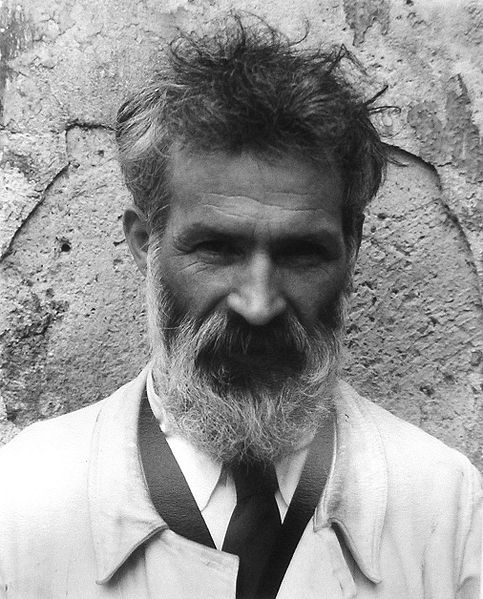
Edward Steichen – Photo (Portrait of Brancusi)

Randall Bloom – Poem (“Brancusi”)

The stone halves
curve in square blocks

inclining toward each
other.

It’s more than
a gesture, more

than stone, more
and

a strand
of hair,

a parting
lip, and ex

halation, un
bending,

out, and
curving
in

Len Davis – Teaser (“Gaining a Daughter: A Father’s Transgendered tale”)

The beginning of an important – and very engaging – essay by my friend Len Davis, from The Chronicle of Higher Education, a few years ago.

The full essay is here: http://www.lennarddavis.com/downloads/gainingadaughter.pdf – PT

I look around and find myself, strangely enough, in the women’s lingerie section of the Kmart in an upstate New York town. I am with my 19-year-old son, who is comparison shopping for a pair of black tights. Some farm ladies are regarding us with dubious glances. My son asks if I think medium is too large for him. He stands at about 5 feet 11 inches. I really have no idea what will fit him. Trying to be helpful, I suggest that he might want to wear the fishnet stockings, which seem to me a bit more goth, but he sticks with the regular
ones. Then we move on to the cosmetics section for lipstick and hair dye. As I help him pick out a L’Oreal shade called Parisian Black, I wonder to myself how I got here.

How indeed? A few days earlier, my son had arrived back from his first year at college. The following morning, he sat me down at the kitchen table and announced that he had a big thing to tell his mother and father. My wife was on the telephone, and as we waited for her to finish talking, my son whispered, “I’m getting married.” Then he added, “No, just kidding.” He was jumpy with nervous intensity. When my wife sat down, he spoke: “I’ve been thinking about this for a long time, and I wanted to tell you — I’m transgendered!” He looked pleased with himself and somewhat triumphant. My wife and I looked at each other, confused and horrified.

Gerry Crinnin – Poem (“Never Forget, Larry”)

Never forget, Larry, the fall night I fell

off a cliff trying to save Carol’s sandal,

blowing kisses all the way down to Lake Erie

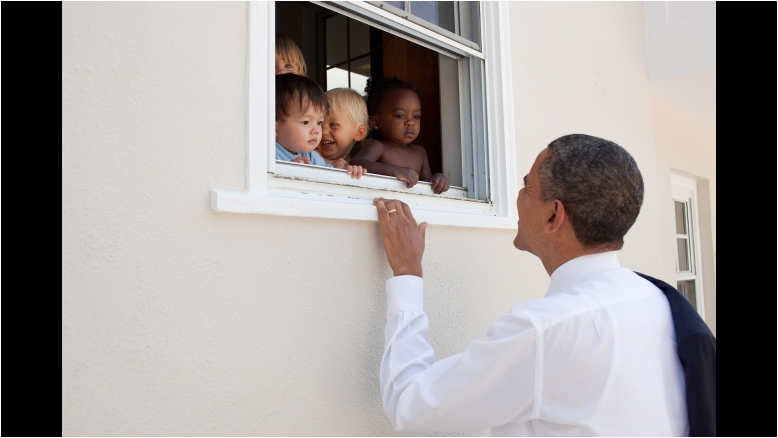
Pete Souza – Photo (Obama at Window with Children)


Peter Temes – Radiation

My father – Lloyd Temes – was a teacher, though teaching was not his first profession. He’d become an engineer after finishing his degree at New York’s City University. He was surprised, though, by how little joy he took from corporate and military engineering.


Before he was out of his twenties, he began his first high school teaching job. It put him on a trio of busses each day, twice a day. He felt the pull of his new life – he now knew that he was a teacher, born for this kind of work – but his school was too far from home. When a spot opened up at a top math-and-science high school in much closer to his home in Brooklyn, he leapt.


He loved teaching. Three stories capture that love. None are about what he taught; all are about how he taught, and how he learned.


The first takes place in the junior high school he attended, though the important prologue to this story begins in fourth or fifth grade. “The teachers could really have a bad attitude,” he recalled later about those 1940’s classrooms. “And one day when a teacher made a particularly obnoxious remark, I climbed up on my desk and punched him in the nose.” This would have been in fourth grade, maybe fifth. My father might embellish a story now and then, but I believe this one. He never shied away from conflict, and he was unstoppable when he thought he was right.


Fast forward to junior high school. By seventh grade, my father was on what he later called the “pre-delinquent track.” He’d been put in a program for poorly-behaved students. They had minimal academic classes and spent most of each day working in the school’s printing shop under the guidance of a famously tough man named Johnny Fontana who had never been to college, was lucky to have a steady job away from the usual dark and dangerous sites of his industrial printing trade, and found in my father a boy with talent.


Fontana set firm limits for my father’s behavior and enforced them. Certainly it helped that he was bigger and stronger than the boy. He saw that my father had some natural aptitude for math and pressed him to study for one of New York City’s “challenge exam” high schools. Along with thousands of other New York City students, though perhaps the only representative of the pre-delinquent track, he sat for the exam and to the shock of many he passed. He entered Stuyvesant High School and worked like coal miner every day to earn passing grades. He was, my mother later observed, a plodder: bit by bit, he would work at every problem. More through determination than flashes of insight, he would get the work done, pass his classes, and hold onto his place in this elite institution.


Another story. My father made his way to the faculty of Brooklyn Technical High School – a school that held much in common with Stuyvesant – partly because he could teach physics, but partly because he could teach the radio electronics shop course there as well. Brooklyn Tech did not offer a pre-delinquent track, but the least-appreciated among the school’s bright students would often wind up taking shop. So my father knew them, and knew them with some of the warmth he remembered from his own shop class in junior high school.


Once day, he later told me, there was a rumor spreading at lunch that two groups of tough kids at the school had formed into gangs, had knives and chains, and were going to do some real harm when the school day ended. When the final bell rang, my father peeked out from the radio shop – not much bigger than a closet, he said – and saw a scene out of West Side Story: the toughest of the tough boys was at the head of a phalanx of his followers, heading quickly down the hall toward his opposite number. The leader of the first group ran within arm’s reach past the radio shop door. My father reached out, grabbed him, pulled him in and locked the door. “End of riot,” my father reported a couple of decades later, still quite proud of himself.


My father had a lot of stories like this, and I know that he believed in them fully. That was part of who he was – and a big part of why he was a great teacher: he was a believer.


A final story. My father taught high school science in the age of Sputnik. The Russian marvel, the first man-made object to orbit the Earth, unleashed a flurry of anxiety over the “science gap” and a river of money meant to supe up science in American schools. One particular experiment began with the interesting observation that helping average teachers become better at teaching might do more good than luring more top performers into the classroom, if only because there are (by definition) so many average teachers. The National Science Foundation was, therefore, given a sizable amount of federal funding to identify a group of average science teachers and place them inside the nation’s cutting-edge research facilities to see whether this exposure to the best and the brightest might inspire the teachers to better-than-average heights.


My father was one of those lucky average teachers, and his experience leaving Brooklyn to work for a season inside the University of California’s Lawrence Radiation labs did indeed transform him. But not at first. He arrived at the lab and was given a fairly mundane task, presumably well suited to an electrical engineer like my father. He was asked to make lightening.


In certain of the large vacuum chambers at the Radiation Lab, scientists were splitting atoms and sub-atomic particles were (they hoped) shooting off in various directions when these atoms ruptured. But it was all happening microscopically. Without some way to verify the paths of the subatomic particles, the scientists were not entirely sure that they were accomplishing what they thought they were accomplishing. But if the experimenters could throw a bolt of lightning into the chamber precisely when the atom split, the lightening would follow the path of least resistance – the path taken by the spinning-out particle – and light it up for all to see. So my father made lightning, and was fairly content with that task.


Every week, though, he found himself in a staff meeting at the lab, and seldom understood the conversation. He was ready to head home a failure, a science teacher but not a scientist, when a lab-mate asked him what was wrong. I can’t follow it, he confessed. I just don’t understand. Well, what’s your field, the other fellow asked. Electrical engineering, my father said, not expecting the distinction to do any good. Ah, came the reply. You speak another language. When they say this in physics, they mean that in electrical engineering. The language was the issue, the style of reference, not the depth of the concepts.


With this key in his hand, my father opened the stuck doors in front of him, and had a fine fellowship. He came back to New York, came back to teaching, took two master’s degrees at night and went on to complete a PhD part-time. He moved from his high school to a community college electrical technology department. There he used the work of an engineering professor named Mischa Schwartz to translate electrical engineering concepts into more basic language that allowed a generation of technicians without any higher math to do the kinds of repair and maintenance on serious electronics that were previously the province of engineers only.
So this idea stuck with my father through his career as a teacher: it’s never as hard as you think it is. Learn the language, figure out how the other guys are doing it, and you can do it too. The will to get it done is the part that matters most.

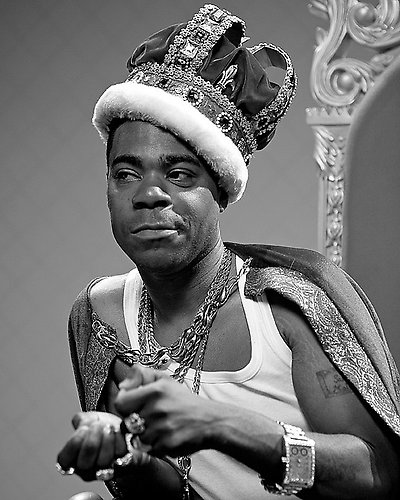
The Editors – Tracy Morgan Thinking Out Loud

Tracy Morgan is an unusual kind of American actor. He’s seems at first glance to be the spilled-upon, not the spiller: the Costello, not the Abbot. But he’s more than that: his recurring character is not only aware of being a character, but demands that we pay for our flashes of superior feelings, rising so quickly we cannot stop them though we know better, with the follow-on thought that we’re being judged for our condescension. His character is nuts, but more than nuts, and nuts for a reason. The audience begins to realize that we are that reason – maybe this unstable character is not performing for us, but as us, or our worst version of our collective self, debased because that’s what it seems to take to win some amount of collective self-approval, or at least self regard of any genuine kind.

And so the fun-house mirrors of ironic intent wrap around his homophobic remarks. Is he playing a man with those ugly thoughts? If so, why is he playing him so well? And why do we watch – not only in spite of, but perhaps because of our revulsion.

The idea of turning away – personally, collectively, immediately – seems impossible. The notion of fighting Morgan on the ground of the literal meaning of what he said, and the seeming commitment behind the words, is ultimately self-mocking. We find ourselves right back to the fundamental question of Morgan’s comedy – does he really mean, or even understand, what he’s saying? And that, alas, seems to be the almost the same as the fundamental question of American public life: Do we really mean, or even understand, what we say day in and day out, about who we are as a nation?

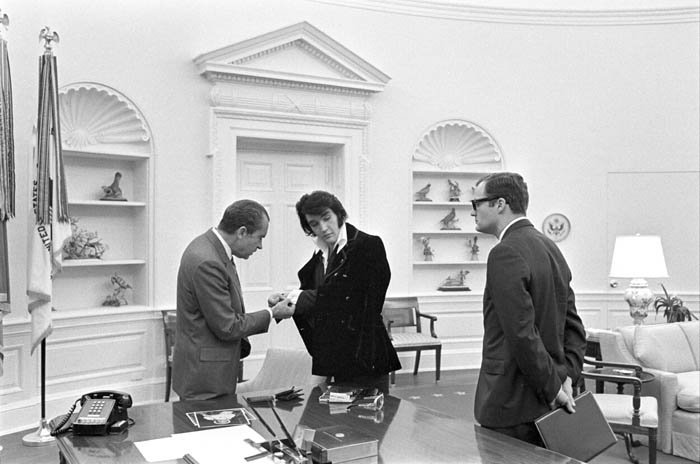
Oliver F. Atkins – Photograph (Elvis Presley and Richard Nixon, in the Oval Office) (National Archives)

Is this your new site? Log in to activate admin features and dismiss this message
Log In
Design a site like this with WordPress.com
Get started