Category Archives: Politics

The Editors – Battles, Stars and Choices

Vying for media attention these days, often neck-and-neck, we find the public self-immolation of actor Charlie Sheen and what seems to be a genuine people’s revolution in Libya.

The modern American revolutionary Abbie Hoffman, upon returning from a decade of living underground – mostly in northern New York State, where he worked as a cook – and taking back up his public role as gadfly and pot-stirrer, remarked that “you can’t be a revolutionary in America without watching a lot of TV. That’s where America lives.”

This was certainly truer when Hoffman spoke these works, when most cities had a dozen channels for viewers to choose among, and the “Big Three” networks were minting money through their media oligopoly. Times are certainly different, but the two sides of the Sheen/Libya coin suggest that the mainstream media are either appealing at once to two remarkably divergent publics, or that thoughtful people have an appetite for compelling if ultimately trivial self-destructive behavior, while the consumers of mindless drivel also care to at least some tiny degree about democracy, human aspiration, and the fate of the world.

If Sheen is a minor Greek god caught mid-fall from Olympus, Libya is the famine or the war taking place closer at hand to the Greek demos. The real and the unreal. The fantastic and the mundane. The distracting and the truly horrifying. We are entertained with the worst kind of voyeuristic circus. And we are offered a glimpse of history’s propulsive force, of human dignity fighting for its life. We seem, as a society to want both stories to be told to us in more or less the place, at more or less the same time.

We seem – as a culture – unable take only part of the sphere of stories that arches over us. Yet each of us can choose to stand closer to this fragment, this figment, this corner of the story-telling world, than that one. We can fight our way over to the meaning of sacrifice, revolution and hope, and claim that bit of space, or we can be buffeted from here to there, be fed the news others want to feed us.

Our choice is not so much which battle to fight, but which battle to watch.

Trivial as that might seem, it’s a choice that matters.

The Editors – Revolutions

Imagine a man in the eighteenth century, a man in Virginia. Autumn in Virginia is lovely, the heat easing, the air less humid. This man is quite wealthy and stands on the front porch of his brick home between white Grecian pillars, looking off toward a stand of trees. He imagines the tallest, his favorite, a tree he specifically declared exempt from the wood clearing needed to build his home – not unlike Jefferson’s home, a few miles away.

That tree, he says to himself, is the one. I shall tell the British commander so. That tree is the tree from which I shall be hung.

He thinks these thoughts because three months earlier, in July, he’d signed a document that effectively declared war on the British, to whom – according to the British – Virginia belonged. Along with about 50 others, this man signed a longish declaration that ended with these words: “And for the support of this Declaration, with a firm reliance on the protection of Divine Providence, we mutually pledge to each other our Lives, our Fortunes, and our sacred Honor.”

If the Americans lost – and odds were in fact against them – certainly he and the other signers would be killed for treason.

We wonder how a man like this made his decision to sign that document. He had so much to lose. The very leadership and visibility that made each of the signers important to the cause made their own potential sacrifices all the more extraordinary.

We bear this in mind as we look over the revolutions in Tunisia, Egypt and Libya. When do you cross your home’s threshold to protest? When is it safe? When ought we do such a thing even if it is not safe? We now see, displayed on the stage of geopolitical theater, all of these questions playing out, with every possible answer played out as well. How fortunate the Tunisians who leapt into the fray as victory was at hand. How awful for the Libyans, thinking of victory in days or weeks, now digging in for a long battle, wondering about the taste of nerve gas, or the smell of napalm.

We note as well this weekend’s New York Times magazine article about Lori Berenson, the young American (now 40) who went to El Salvador and Nicaragua to join the revolutions in those countries, journeyed on to Peru, and found herself in Peruvian prisons for the last 16 years.
Jennifer Egan reports in the Times that Berenson’s brief tenure as a student at MIT led her to her life’s work:

-She began working for Prof. Martin Diskin, who was doing research on the policies of granting political asylum to -refugees from Nicaragua, El Salvador and Guatemala. She learned that those who received asylum were likely to be the -ones fleeing groups that the United States opposed: the Sandinista government of Nicaragua, or the guerrillas fighting -in El Salvador.

-“The others would get sent back to be killed, even though they had been tortured,” she told me. “Why wouldn’t you -give someone who’s being pursued refugee status? Politics. My awakening to the world.”

-Berenson spoke of this revelation with a forceful clarity I rarely heard in discussions of her personal experience, -which she tends to minimize. Her political views, expressed in periodic statements from prison that her parents -posted on their FreeLori.org Web site, haven’t measurably changed over the years; on the contrary, her discovery of -a world built on oppression, exploitation and imperialism has — in Berenson’s view — been ratified by her experience -in Peru. “I realized that behind suffering was politics. It wasn’t just like, Oh, these people are poor and they’re destined -to suffer. No. There are interests behind that — political, economic — in having a social class be relegated to dying in -misery, and being exploited, and being harmed, and suffering repression.”

Berenson may be wrong in her analysis, but if so only as a matter of degree. If “interests” are not wholly behind poverty, surely these interests are at least present, often substantially so, and at times decisive – here as well as there, we are prepared to argue.

The questions that matter most are when and how to stand up and note these injustices, when and how to respond, and how to make one’s own sacrifices mean more than therapy or autobiography.

The Editors – A Glimpse at North Africa and the Middle East

Let’s remember now in the late winter of the season of revolt in North Africa and the Middle East that a few months ago, Tunisia was the first nation to Tweet and Facebook its way to a new era, the fruit of its rebellion grown by the bit and by the byte, by the tweet and by the post.


Today a Tunisian named Heny tweeted this: “To the Kasbah, young Tunisians! The revolution needs us! Free Tunisia from the remainders of the corrupt regime. The achievement is not complete yet.”


As Americans, we find a special appeal in the idea of an unfinished revolution. We remember that we were not even truly free of the British until 1812, their forts and soldiers scattered till then across our country with little regard to American sovereignty.


Indeed, not until 1865 did we end the legal institutions of human slavery within our democracy. And it was not until 1971 that the sheriff in Yazoo City, Mississippi ended his practice of personally escorting black students brave enough to show their faces at once-upon-a-time white schools off to their more expected places at the shacks and shanties reserved for African American education. (Writer Willie Morris tells that tale fully and well in his book Yazoo – written well before his opus, My Dog Skip).


What we see and what we learn today from North Africa and the Middle East are very much about our own national influence, to say nothing of our own national soul. We have a past in this country – both bloody and beautiful, full of promise yet still incomplete in its vision of what American ought to be – that we cannot afford to forget or neglect, particularly when we see its echoes resounding across the world.

The Editors – Sarah Palin, Rebecca MacKinnon, and other “Friends”

We’ve been reading some of the astute comments by Rebecca MacKinnon – former CNN bureau chief in Beijing, fellow at Harvard’s Berkman Center for Internet and Society, and co-founder of http://www.globalvoicesonline.org – about Sarah Palin’s fake-name FaceBook account, a violation of the FB user agreement everyone assents to when they set up an account, and a move generally met with instant deletion when discovered.

An unpublished manuscript making its samizdat rounds in DC contains the tidbit, as well as the fake name (Lou Sarah – go figure).

Which raises some questions.

First, is this really a breach, or just a politician living more or less as we all live?

But a quick second: Is the “Sarah Palin” we know and love, hate, or try to ignore, more real or authentic than “Lou Sarah”?

And furthermore: Rebecca MacKinnon, a public figure in Internet policy circles, is on leave from various posts to finish a book right now (her thoughtful blog http://rconversation.blogs.com/ is on haitus, but still a great read even in its archive-edition status).

So we see Rebecca’s thoughts because we’re her FB friends, and they’re great. But we can’t really make them part of a conversation we’d like to share with you – literally you, the reader – because they’re only there to be seem among “friends.”

Rebecca is intentionally diminishing her posture in both the real and the virtual worlds in order to get some work done. Palin is also claiming some private space online, though she simultaneously makes herself ever-more public through her main FB page, her tweets, and more.

What MacKinnon is claiming in sequence – a smaller presence for now in order to finish her book and have a larger one later – is not all that different from what Palin is doing, though Palin is doing it all at once. She’s being both small and large, public and private, with different personas for each stance.

If that’s unattractive, it may be less because she’s dishonest – it’s hard to call a pet-name FB account the province only of scoundrels – but more because she’s impatient and unprepared for serious thinking time away from the spotlight.

Karen Morris – “A Walk in the Park”

William is my dog. By all customary and conventional measures, Willy is not a nice dog. He is not a dog you would encourage your children to entertain. But I love him. Willy is a sad, mad dog because he cannot forget the abuses of his early doghood before his rescue.

We, like our dogs, are creatures of habit. Up to a certain degree, we nonetheless learn new tricks. Now, Willy, whose nipping victims run into double digits, has no Kaizen ambitions. But the rest of us want to learn and grow, pursue our personal and professional program of continuous improvement, even “reinvention.” Industries and organizations also develop habits, biases and precious assumptions. We talk a good deal about reinvention, but breaking up with habits is hard to do.

And here is the conundrum. Large transformational endeavors, building new and different capabilities for emergent challenges, investing in expansive skill-sets are vital but learning is always easier than forgetting. As de Toqueville lamented for the post- revolution French aristocrats “Ils n’ont rien appris de rien oublier.” They have learnt nothing because they have forgotten nothing. He implies, and surely this is also true of organizational behavior, that what you decide to relinquish and jettison can be more vital to learning and reinvention than what you try to embed as new practice.

Every Sunday, I walk my dogs in Brooklyn’s Prospect Park West. We make our familiar circuit. The parallel of strategy and budget cycles in large organizations springs to mind. There’s some unpredictability. At what point in the process will one be called upon to perform the scoop, conceal and dispose ritual. The corporate analogy abides.

It was a light-winded lucid September morning. I decided to take the road less traveled. Prospect Park is the sibling of Manhattan’s Central Park and married less well. The Manhattan match, despite difficult patches, has been more generous than the Brooklyn liaison. Prospect Park offers up her memories in dilapidated corners and dejected masonry. But we love her. So I broke my habit, to momentary canine confusion, and wandered into a quiet lakeside trail. I was thinking of Emerson, although this was no Walden Pond, of de Tocqueville, although this was no Grand Tour, and of what to make for lunch – although I rarely cook on Sundays, I like to live the fantasy. “My gift of fantasy” Einstein asserted, was more valuable than intellect. Disingenuous or not, the recognition that “genius” is sparked at the intersection of imagination and intellect is increasingly relevant to corporations seeking to innovate.

At a more prosaic intersection Willy (a.k.a. “Satan’s puppy”) slipped his leash. Now I’m thinking of the nip-vulnerable ankles of unsuspecting birdwatchers. Since William is about 170 in human years, the sprint was bursty and brief. This is when we came upon it. Ambergill: “The Lost and Found Fountain.”

The funny thing about people is our tenacious adherence to the creed of knowledge. The funny thing about organizations is their tenacious adherence to the creed of experience. We are what we know and we are the sum of what we’ve done. These conventions hold that future action and capacity can be extrapolated from this instant summation of the person. This is a seemingly irresistible thesis and encouraging in its confidence that tomorrow will be just like today; that tomorrow’s business, social, political, cultural needs can be met by yesterday’s experts. You would have to be barking mad to buy that.

Numerous surveys whose responses are inevitably imbued with the gravitas and authority of the surveyor: McKinsey, Booz Allen, The Economist etc. (that not even remotely, motley crew) exhort us consistently to innovate, to jettison received opinion, to question and create (to slip our leash). Change has changed in velocity and scale. So too must we, or we’ll be left behind. We can avail ourselves of processes to smooth the transition. The sticking point is that ex ante crisis, few businesses and even fewer successful people perceive their “core competence” as bathwater rather than baby. Faced with corporate infanticide, best to puncture the tub so the assumptions and practices of others can seep incrementally away without danger to our baby. Hell, Sartre may have concluded, had he ever had a “real” job, is other people’s habits.

My first question in assessing the innovation ambitions of any business is always “What would you never change?” This is as economic as existential as diagnoses get.

Having caught up with the capricious canine, I paused. Pausing is underrated as an action. I recommend it. I read the story on the Prospect Park Alliance guide. Ambergill was lost, literally. The waterfall had been swallowed up in the overgrowth and had disappeared for decades until its very existence was forgotten.

Imagining that which does not yet exist is the creative gymnastic that catapults innovation. When Frederick Law Olmstead, possibly the innovator of landscape architecture, and Calvert Vaux conceived and designed Prospect Park following their landmark creation Manhattan’s Central Park, the traces of the Civil War battles had not yet disappeared.

Men and boys died on the rocks and soil where this then suburban nature-scape would be. Envisioning a park out of a battlefield epitomizes transformational change.

A (civil) army of immigrant workers would hand- dig the expanse of lake, little imagining that a century after them this exquisite man-made sanctuary would be the hub of a jogging loop and that spitting, swearing men in Lycra on titanium bikes would hurtle past both battle memorials and botanical beauty unaware.

The architects did not imagine themselves in the business of transience. Projects of such ambition and scale went from good to great. A celebration of a high-growth, vibrant economy. Absorbed with our currently successful core businesses, we rarely anticipate stagnation and irrelevance. The architects could not have envisioned that urban decline and financial strife would cause Ambergill to be taken back by nature and quietly disappear.

Great design and bold intent (and the conflation of the two) do not expect obsolescence and evaporation. These are built to last. Alpha leaders of any pack must exude confidence in continuity. But the tendrils of change insinuate their way in, at first subtly, then more aggressively until it is too late. We just don’t see it coming.

William was retrieved quickly, this time. Ambergill slowly. The important feature of Ambergill’s rediscovery is that it was an accident, a lucky coincidence of another investigation. If we keep open to accident and re-discovery, we can actually systematically find new insights from apparently unrelated sources. Just because the fountain was not new does not mean its recovery was not discovery. There is innovation inside the box, if we probe and question.

That is the innovator’s, designer’s, searcher’s, investigator’s business. We form unlikely and improbable relationships with bad ideas; then forge a powerful idea from that union. We create synthetic patterns and then step outside of them, exploring another track. We get lost and see what that experience reveals. We let go of what we know in favor or what we might discover. We never cease to be surprised.

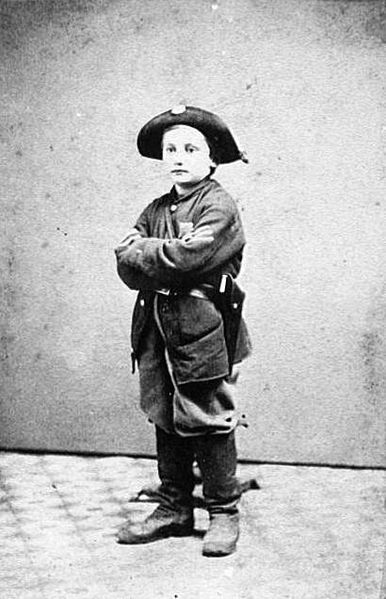
Unknown Photographer – Child Soldier of the Civil War

AmWord Editors – Egypt’s news for Iran, Pakistan, China (and the US)

Global Voices Online remains an essential source for the ideas and real-time testimony of citizens and others on the inside of political change around the world.

We recommend a visit to http://globalvoicesonline.org

Today the site features stories of protests in China, Iran and Pakistan, all tied to the profound victories won by protesters in Egypt.

What Egypt now means for these countries and their leaders is an open question, but it is being rapidly answered.

What it means for the U.S. is less clear though also vital.

Our sense: less power for the extremes and the polarizers, more for the thoughtful middle.

Note that the events in Egypt were driven by a citizen-body of democratic centrists, friendly to the military and successful at keeping religious and revolutionary extremes out of the mainstream of their protests.

Bobby Rush, the former Black Panther party leader in Chicago, upon being elected to the U.S. Congress in the early 1990’s notably said that “the only difference between my views then and my views now is that back then I thought that the number one thing the average black man wanted was revolution, while now I realize that all along what the average black man has wanted most is decent work and a quiet home.” In some places this may well require a revolution, but revolution itself is never the point – something we may all come to understand more deeply in coming weeks and months.

Muhammad Ghafari – Photo (“In Egypt”)

Peter Temes – The Kings Go to Montgomery

In 1954, about 100,000 people lived in Montgomery, Alabama. Boston was home to more than 800,000. Philadelphia, more than two million. New York City, about eight million.

That year, Martin Luther King, Jr. and his fiancée Coretta Scott looked back to the South from their temporary homes in Boston. They also looked to Philadelphia and to New York, where King was engaged to preach as a visiting minister during the months he was seeking his first pulpit. His graduate work was almost complete, and his profile was a sharp one among the small number of university-educated African-American ministers looking to make their mark.
King was a product of Atlanta, where his father was a notable minister and senior member of the city’s African American establishment. Certainly King had felt the racism of the American South first-hand, but Atlanta was a city he understood, and a city where, moving mostly within the black community as he grew up, he had the advantages of a known and respected family entrenched in the largely self-contained, prosperous black middle class.

Coretta Scott was born in a different South – – not the big city South, not the South of black ministers in new cars and black businessmen with money to spend. She was born in the small town of Heiberger, Alabama, and knew the brutalities of the deep and local South. Her family owned land, but lived a modest life and depended on the good will of white people whose economic interests often ran counter to the Scott family’s well being. Her father was a dirt farmer, but he also ran a trucking business, and made enough money for Coretta Scott to contemplate attending college in the North. She graduated from Antioch College in Yellow Springs, Ohio (on full scholarship) and facing her likely career as a teacher, she chose instead the unlikely life of a professional singer and went to study at the New England Conservatory of Music in Boston, where she met Martin Luther King.

They were married on the Scott family farm as King was considering the options before him: go North to a pulpit; seek a college teaching job; or take a pulpit in the South. In the South there would be many options for a talented Northern-educated African American preacher. But, outside of Atlanta, the South would be a different world. And for Coretta Scott King, there would be no professional life in music; simply none. Her consolation, as she raised her children in the world of Jim Crow which she knew well – – and had, she thought, abandoned for good when she went North – – would be singing in church.

Upon his first visit to Dexter Avenue Baptist Church, the Montgomery, Alabama church that turned out to be King’s first pulpit, he found a church organ in disrepair. “We had a letter yesterday from the St. Louis company,” the Dexter Avenue church clerk wrote to King as he was negotiating his employment agreement, “indicating that a man will be coming in from Atlanta on Monday to dismantle the old instrument,” a hopeful sign that a new church organ would eventually arrive. He found the parsonage bare of furniture (the first of his three conditions for taking the job was “That the parsonage will be completely furnished”). And he found a church with plenty of need for a preacher – – perhaps too much. On his second visit to meet with the pulpit committee as a finalist for the job, King was told “there is also a possibility that we may wish to have you baptize about five candidates either at the morning hour or at an evening service which we could plan.”

And a friend who knew the church encouraged him to take the job with this left-handed praise of the congregation: “Take it from me, that is a Great Church, Mike. Much honor will go to the man who gets it. Frankly, I have fallen in love with those people. Don’t let anybody tell you that that church is such a hell raiser!”

No doubt Coretta was warmly received as the new preacher’s wife, but her life in Montgomery would be far from the freedoms of North, far from the musical stage, and far from the independence of her few years in Boston. She would be going to a church with a bad organ, in a town with a rough racist reputation, to a home with no furniture, to live in the shadow of her husband the minister, as well as the shadow of her husband’s notable Southern church family. “Wonder if Alberta would not like to come down with you,” wrote the church clerk to King as he planned to travel down from Boston to deliver a guest sermon. The clerk was speaking of Alberta King, Martin Luther King’s mother. “Tell her we would be very happy to have her if she could make it. Let me know when to expect you and whether or not your wife will accompany you.” Someone else, apparently, would have to tell Coretta that the leaders of Dexter Avenue would be very happy to have her if she could make it.

King describes his decision to go South in his book Stride Towards Freedom: Coretta, he wrote, “was hesitant about returning south. We discussed the all-important question of raising children in the bonds of segregation. We reviewed our own growth in the South, and the many advantages that we had been deprived of as a result of segregation. The question of my wife’s musical career came up. She was certain that a Northern city would afford a greater opportunity for continued study than any city in the deep South. For several days we talked and thought and prayed over each of these matters. Finally we agreed that, in spite of the disadvantages and inevitable sacrifices, our greatest service could be rendered in our native South. We came to the conclusion that we had something of a moral obligation to return-at least for a few years.”

The King couple did more than return South – – they went local. They went to a city small enough that America was in some ways a distant place. They went to a town of 100,000 where white men who killed black men or raped white women did not go to jail. Where black men in jail were taken out to prison farms to stand in shackles and work the soil while white sheriff’s deputies stood over them with shotguns. Where, as a matter of law, white people and black people could not sit together on public busses, or eat together at local restaurants, or drink from the same public water fountains. Where the rights of black people were unacknowledged by the local agents of the law, and where, beyond the local, there was little law to be found. King’s words in Stride Toward Freedom about the decision to go South and to go local might sound a bit glib or self-congratulatory, but without a doubt Martin Luther King and Coretta Scott King were giving up a great deal in moving from Boston to Montgomery.

Coretta was giving up her prospects as a professional musician, and accepting the obscurity of, at best, a church choir. And both were giving up the sense of public space that many citizens feel in big cities, the sense of being at the center of American culture, and accepting in its place the obscurity of places other Americans don’t know about, and for the most part don’t care about. They were going from a brightly lit life to a place with more shadows than light for educated young African American people. By going local, they were going far from their homes in Boston and far from King’s family home of Atlanta, with the hope of doing some good.

Peter Temes – An Invitation

I have an invitation to a reception at the home of the ambassador of a Middle-Eastern nation on my desk. I plan to attend.

I assume that no one will talk about Egypt. A circle of invitation large enough to include me surely indicates that nothing much serious is expected. It is a social occasion, and I am in fact tempted to consult my own embassy for advice on expected clothing, conversation, and comportment.

To wit: the invitation does not indicate black tie. Is that simply taken for granted? A rube like myself does not know. And I am sure that we are not expected to bring chocolates or flowers. Right?

It’s at a big house in a neighborhood of mansions – the ambassador’s house. They’ valet my car. Or will they? Either way I think I lose. At a minimum, it will take an hour to clean the inside of my embarrassingly modest Nissan so that the car parker/bodyguard/spy who valets it won’t a) come out covered in crumbs from the crusty bread my wife and I like to pick up and munch on when we drive home sometimes, and b) get the wrong idea from the surplus East German gas mask our 12-year-old son keeps in the car to freak out other drivers. It’s a tight-fitting rubber bladder with goggles for the eyeholes and a bendy pipe leading to a metal disk meant to hold a filter running from the mouth. A guest planning no mischief would likely not bring one to dinner. It’s a sign of trouble.

And trouble we have plenty of today, particularly in the Middle East. Perhaps the good kind, the kind that brings what Martin Luther King used to call the latent tensions below the surface to the light of day – trouble that’s overdue, that brings change, that reminds us that fundamentally we are all the same, that the distance from East Germany to Cairo to Beverly Hills, where I expect to dine soon enough, is not great.

Today, I hear people who seem to know about these things say that what’s happening in Egypt will almost certainly be good for the peace process there because, of course, governments that do not truly represent their people, that themselves are never truly AT peace, cannot truly MAKE peace. How sensible this sounds. How odd that we have heard it said so little in the recent past.

And so I resolve to attend the party at the ambassador’s house, already thankful for his hospitality but wondering how polite one really ought to be.

Is this your new site? Log in to activate admin features and dismiss this message
Log In
Design a site like this with WordPress.com
Get started